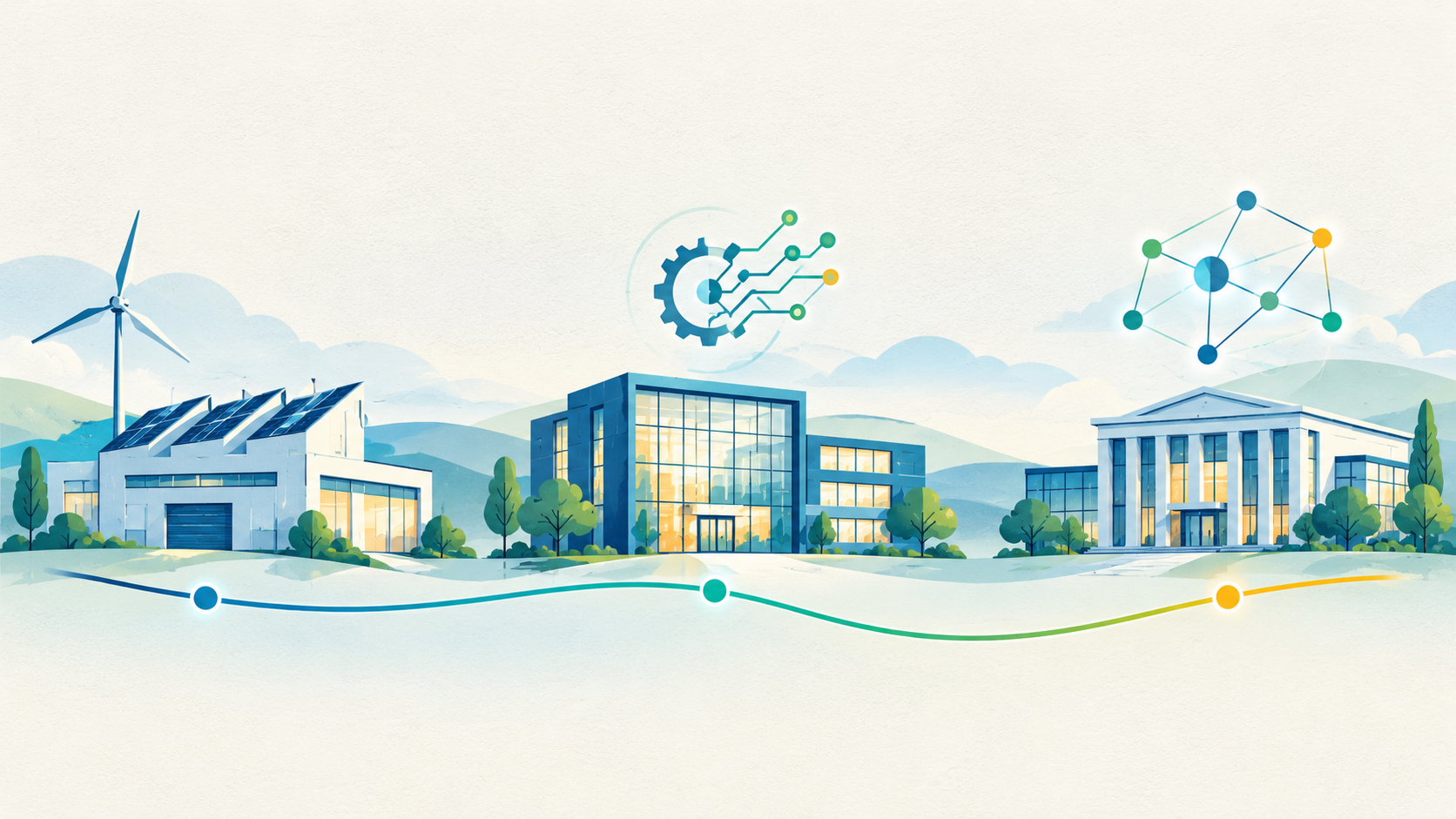
Industrial park, technology park, science and innovation park: these three terms are often confused in everyday life, even though they have completely different goals and different actors. The difference can be captured by a single question: what is the park built on? The factory line, the development team or the university lab?
In Hungary, it is not enough to call an area a park. The titles are determined by law, Government Decree 161/2023. (IV. 28.), and each must be awarded through a tender. All three types perform different tasks in the economy, and together they complete the chain that leads from the idea to the finished product.
Industrial park: where the factory lines spin
The industrial park is the best known of all. Ready-made plots, built-in utilities, good transport connections: everything is provided for a company to quickly move in and start producing. The goal is to attract investment and create jobs.
The Industrial Park title has existed in Hungary since 1997 and has since become the economic engine of many settlements. It is typically owned by a local government or the organization developing the park. The title requires an area of at least 10 hectares and at least five businesses must operate there at the time of application.
Technology park: where the product is born
The technology park goes one step further. Here, companies not only manufacture, but also develop: they work on new products, processes and technologies, often together with each other and with universities.
The basic requirements regarding the area and number of enterprises are similar to those of an industrial park, the difference lies in the content. It is not uncommon for an industrial park to „grow up” into a technology park: when the established companies start research and development collaborations, the manufacturing area becomes an innovation community.
Science and innovation park: where research becomes business
The youngest category was introduced by the government in 2021, with a clear goal: the knowledge created in university labs should not remain on the pages of studies, but should reach companies and everyday life as quickly as possible.
The crucial difference is who owns the park. This title can only be held by a higher education institution, its maintainer, or the organization they manage. So the center is not an industrial area, but a university, around which companies, startups, and researchers are organized.
Each such park has one or more focus area is built on: a strategic field of expertise for whose development the park provides the background. Here, researchers, students, young entrepreneurs and corporate developers can work together in one place. Typical activities include:
- experimental and pilot environments where new solutions can be tested in real-world conditions
- incubation of startups and technology businesses
- technology transfer, i.e. bringing research results to the market
- practical training, where knowledge becomes immediately applicable skills
Zsámbék: the workshop of the future industry
The Zsámbék Future Industry Science and Innovation Park belongs to the third, most knowledge-centric category. It is jointly developed by Óbuda University and the Zsámbék City Government, and together with the university's Mechatronics and Smart Industry Parks in Székesfehérvár and Kaposvár, it forms a national network.
The focus of the Zsámbék park is the industry of the future, and it already has tangible pillars:
- cybersecurity training and operations center, where digital defense can be learned in practice
- energy community platform based on artificial intelligence and IoT system, which supports smarter, community energy management
- AR/VR/XR research and prototyping lab, where industrial applications of augmented and virtual reality are born
These fulfill exactly the role that science and innovation parks were created for. They connect university research with corporate practice, training and the local community, so that the technologies of the future work not only in the lab, but also in real life.